C³: Community, Creativity, and Change
by Sabina Cveček
During the MCAA Annual Conference 2024, the Communications Working Group organized an exciting blogging contest. Participants were invited to write insightful blogs covering various sessions throughout the conference and capturing key insights. After receiving several compelling entries, the best entries, showcasing exceptional quality and reporting, were published and honored with awards. This contest not only encouraged attendees to engage deeply with the conference content but also provided a platform for sharing diverse perspectives and highlights from the event. This initiative fostered active participation and highlighted the conference’s rich array of topics.
--
“And the award for the best lightning talk in the category ‘Social Sciences, Humanities and Arts, Career Development, Sustainable Research Practice, and Science Policy’ goes to Sabina, err―I will not pronounce your surname. You know who you are, so please come to the stage.”
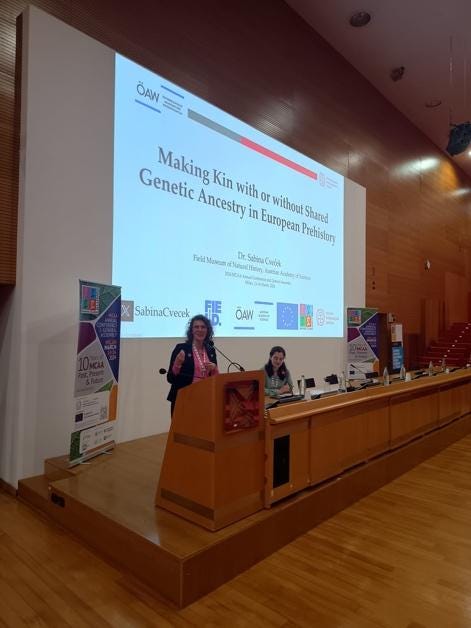
And with that, with the preternatural feeling of Maria Skłodowska’s reassuring Slavic presence by my side, I was delighted to receive the accolade for my talk Making Kin with or without Shared Genetic Ancestry in European Prehistory at the Marie Curie Alumni Association (MCAA) Annual Conference and General Assembly in Milan in March 2024.
While, it is hard to spell Cveček, it is harder to be a Cveček―heck as a kid it was even harder for me to pronounce Cveček [tsveh-chek]!
But if Slavoj Žižek has been able to forge his path into academic and global media stardom, what do I care about the Milan hiccup? ―or even about the week prior in Ankara, where my surname was tweaked to Çiçek as I delivered a talk at the Museum of Anatolian Civilizations. One step closer to Slavoj, I guess?
In Ankara, sitting next to me in the audience was the Slovenian Ambassador, Gorazd Renčelj, whose observation will stay with me: “I think they have adopted you,” referring to the fact Çiçek means flower in Turkish. With my current MSCA X-KIN project on prehistoric kinship, I appreciated the kinship reference.
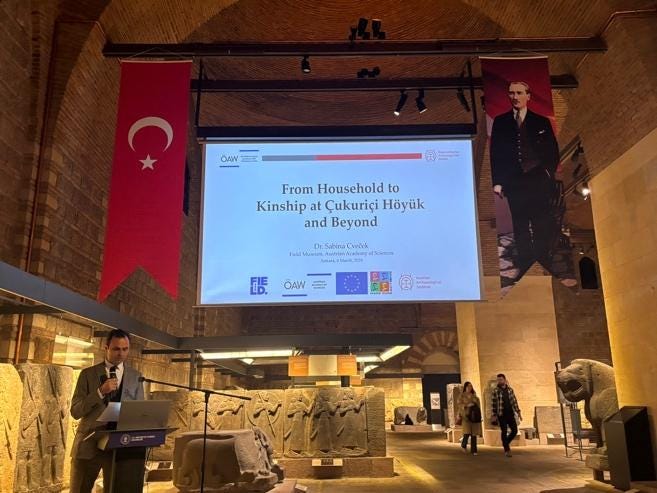
Neither in Ankara [1] nor in Milan was my surname handled with ease. While it may take a while before the world steps up the efforts to accommodate Slavic surnames in academia, the pleasant surprise I found, specifically in Milan, centered around a type of scholarly kinship, and a feeling of acceptance, amidst peers who were more than just scholars of kinship.
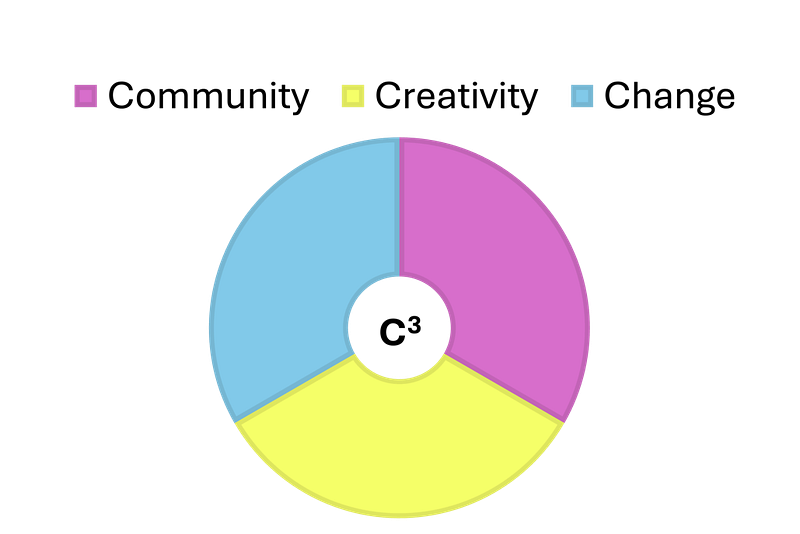
At the event, I observed three common denominators in the sessions I attended that inspired me: community, creativity, and change―specifically fostering a sense of community, encouraging creativity, and a need for change.
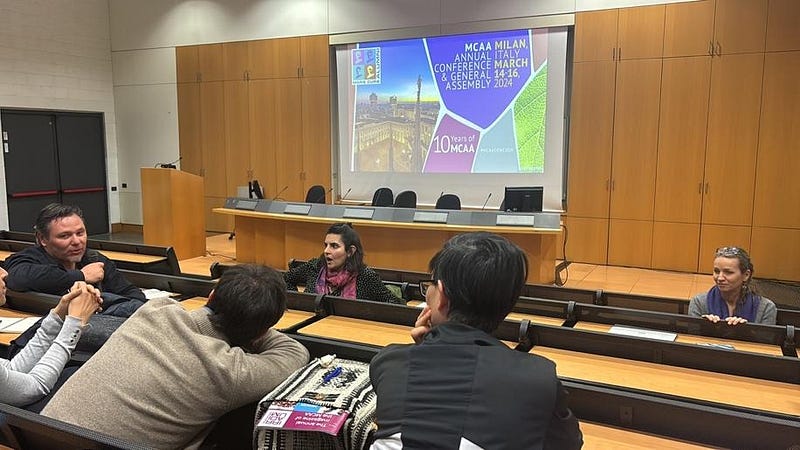
Academic community plays a diverse role for early career reserachers, and I must say, in this regard, MCAA was the most diverse conference I have attended. It was particularly moving to learn how all of us, including cultural anthropologists, population geneticists, political scientists, engineers, mathematicians, and historians, to name just a few, are pushing boundaries, thanks to the mobility component of the Marie Curie program. Our cross-sectoral community pairs scientists in academia and in industry, policymaking, and project management, with a common aim: the betterment of working conditions for early career scholars and strengthening relations between citizens, policymakers, and scientists.
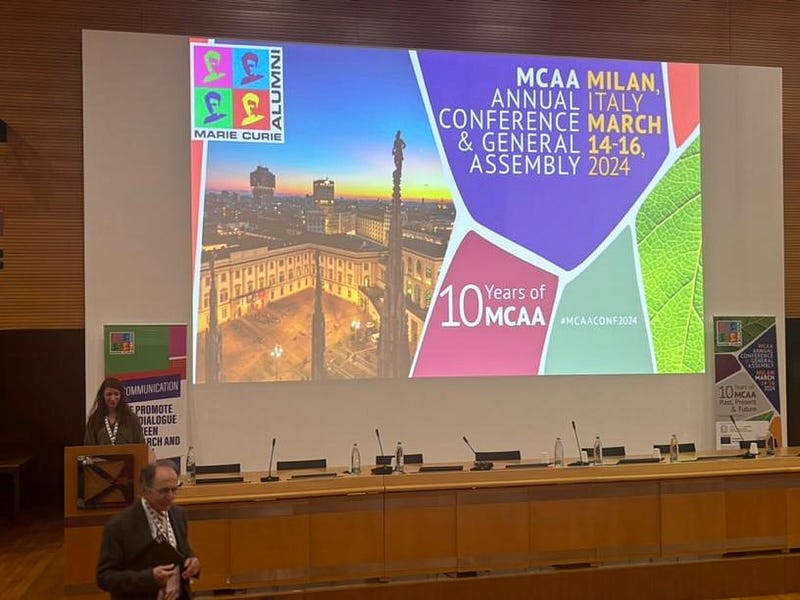
Even in the Opening Ceremony, Fernanda Bajanca, the outgoing chair of the MCAA, underlined the importance of a community such as the MCAA in a way that was refreshingly sincere — not only inspirational. Her sentiments were echoed by Martin Andler, the president of the Initiative for Science in Europe (ISE). He advocated for deliberation, meaning a thoughtful discourse, and pluralism in decision-making on a European level while integrating communities like ours into policymaking. Enthusiastic words by Giovanna Iannantuoni, the rector of the University of Milano-Bicocca, also motivated us to think about Change while welcoming us to Milan.
Throughout the MCAA event, creativity took center stage. For instance, innovative research and chapter activities were spotlighted. Joaquín Capablo, the newly elected MCAA vice chair, shared in his lightning talk a wide array of inventive activities organized by the MCAA Spain-Portugal Chapter. These included a photography contest exploring the intersection of art and science, a scientific short poetry contest celebrating the love for science, and a podcast contest in anecdotes on CONFUSCIENCE — Confusion in Science.
Clearly, creativity goes beyond our workplaces. It can be fostered through photography and storytelling as well as through writing of poetry and prose, a welcome change from a formal style of academic writing.
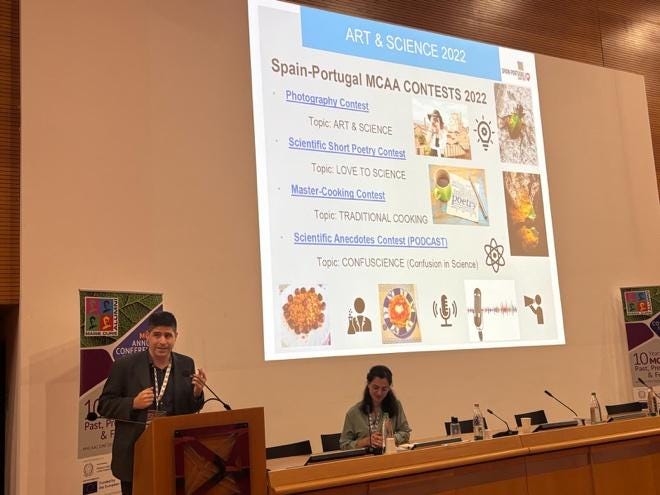
In Milan, I gathered plenty of insights for my appearance on the “Confusion in Science” podcast — itself an entertaining and educating journey. During a session aimed at enhancing MSCA supervision, I innocently questioned Alexandra Dubini about her involvement, not realizing she was the MCAA vice-chair who had just finished her time in the position! Sadly, my faux pas did not end there, and in a chat with Martin Andler, I naively asked if the ISE, where he is president, was an NGO. Both instances were met with laughter and nods, reminding me of a predicament I have been facing since becoming a Marie Curie fellow: how to balance my scholarly research while researching who is who in areas outside of my field?.
These moments from the conference will stay with me as humble reminders of the learning curve I am still embracing.
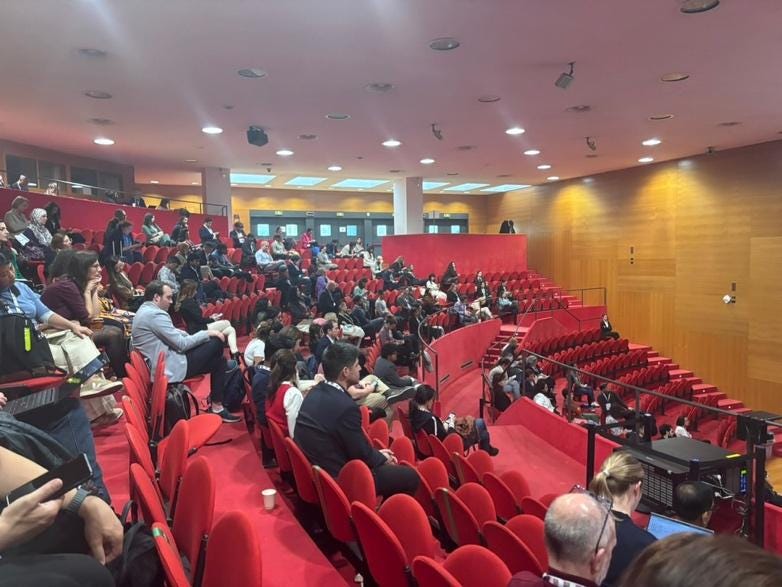
The third aspect that crosscut all panels at the MCAA Conference was the need for change. While this may be the hallmark of all generations that engage with critical thinking, here, the sentiment was echoed by Maria Leptin, President of the European Research Council, who specifically emphasized the importance of increasing European Union’s research budget. Many of us attending the conference shared an appreciation for what it means to be a well-funded postdoc or doctoral student, with means for attending conferences, fostering new international collaborations, and disseminating our results. However, the MSCA research projects are short-term. Hence, Renaud Jolivet advocated for a shift towards supporting fundamental research and sustainable funding, moving away from the traditional project-based model. The discussion also ventured into the evolution of research assessments, with Sean Capcariu and Pooja Khurana highlighting the transition to narrative CVs through the new pep-cv platform, aiming to embrace a wider variety of research paths and foster inclusivity. This consensus on the need for transformation underscored the conference’s forward-thinking ethos and one I hope will have ripple effects in the many corners of the world represented that day in Milan.
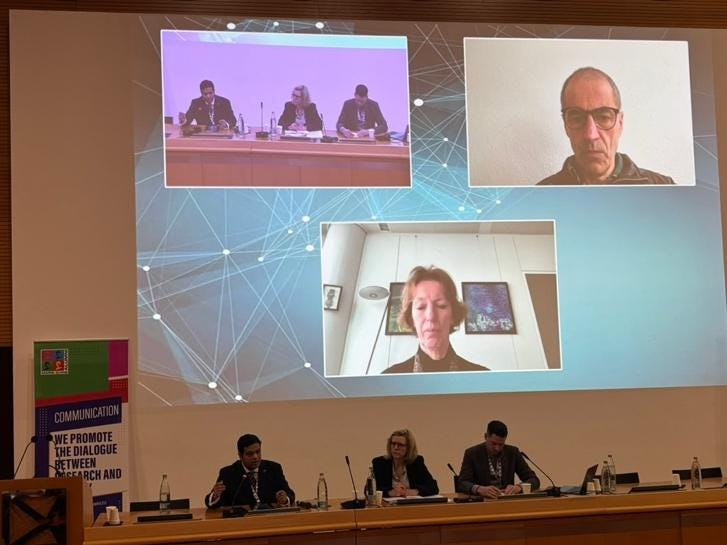
Finally, fostering mental health, which truly is not discussed often enough, and sustainability in academia, remain priorities for the MCAA. Recently, the MCAA published a special issue on the topic of mental health and established a new working group on sustainability.
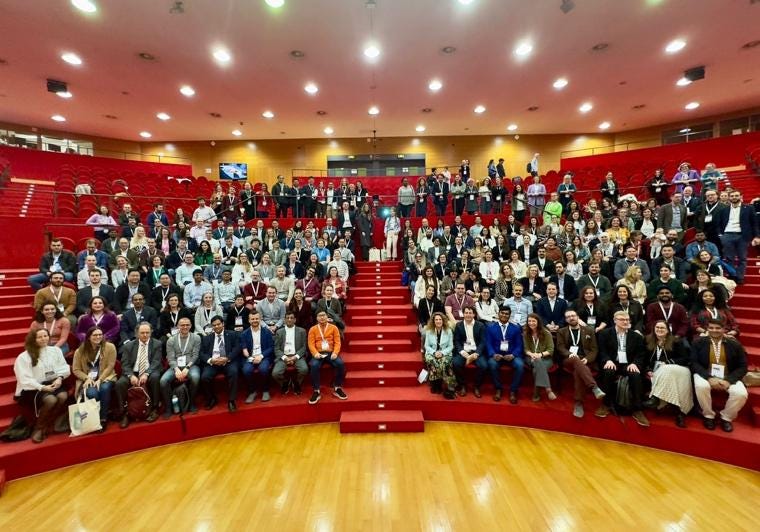
The concept of community, deriving from the Latin communitas with its dual connotations of an unstructured community of equals and the spirit of community, resonates deeply with the MCAA’s efforts. This notion, particularly significant to me as a socio-cultural anthropologist, brings to mind Victor Turner’s distinction between “structure” and “antistructure.” Turner highlighted communitas as a crucial aspect of antistructure, a temporary and unstructured state where community members are equal, facilitating shared experiences. Such experiences, often part of rites of passage, foster community strength by momentarily leveling societal hierarchies.
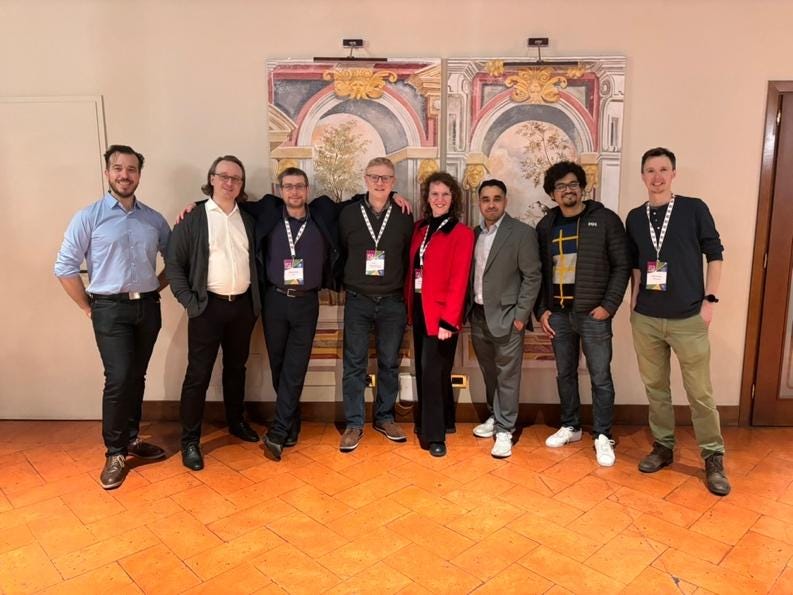
And while a rite of passage for some and a familiar return for others, the MCAA impressed me for fostering a space that dissolved hierarchies among members during its three-day event, creating a shared experience that nurtures creativity, dialogue, and equality in addressing concerns and proposing changes. The conference not only serves as a vital forum for dialogue and policy exchange but also marks the beginning of a newly elected Board, led by Gian Maria Greco, tasked with continuing to nurture these bottom-up, community-based (hi)stories about which we heard in the panel “Reflections on the past 10 years.” In those years, the MCAA communitas grew from a few to 21,000+ members, which is a remarkable achievement. I am delighted to be a tiny but appreciated part―with a strange surname―in this sum.
With this, I draw a “c” cubed (C³) from the Community to Creativity and Change back to its fundament, which is the community.
[1] Read more about my visit to METU — Middle Eastern Technical University’s Comparative and Evolutionary Biology Lab here.